In eCommerce, visuals are no longer just marketing assets — they are revenue drivers.
Every product image on your website influences how customers perceive your brand, evaluate product quality, and decide whether to make a purchase. Yet many businesses still treat product photography as a one-time task instead of building a visual system designed to scale revenue.
Professional product photography is not just about making products look attractive. It is about creating consistent, conversion-focused visuals that improve customer trust, reduce returns, and increase sales.
In this blog, we explore how structured visual systems and professional product photography deliver measurable return on investment (ROI) and help eCommerce brands grow faster.
What Is a Visual System in eCommerce?
A visual system is a structured approach to creating, editing, managing, and publishing product images across platforms.
Instead of randomly uploading photos, successful brands follow consistent standards.
A strong visual system includes:
- Standardized product photography guidelines
- Consistent lighting and backgrounds
- Uniform image dimensions
- Professional retouching workflows
- Platform-ready image optimization
When these elements work together, product visuals become scalable assets that support business growth.
Without a structured system, brands often struggle with inconsistent product images, slow production workflows, and weak customer engagement.


Why Professional Product Photography Matters More Than Ever
Modern online shoppers rely heavily on visuals because they cannot physically touch products.
Product images must:
- Clearly show product details
- Represent accurate colors
- Highlight texture and materials
- Communicate quality instantly
Professional photography helps achieve these goals.
Unlike casual photography, professional product images are created using controlled lighting, high-resolution equipment, and expert styling techniques.
This results in:
✔ Better product clarity
✔ Stronger brand presentation
✔ Increased customer confidence
When customers trust what they see, they are more likely to complete purchases.
The Direct Impact of Product Images on Conversion Rates
Conversion rate is one of the most important metrics in eCommerce.
Even small improvements in product visuals can lead to significant revenue growth.
High-quality product images help:
- Reduce customer hesitation
- Improve product understanding
- Increase perceived value
- Encourage faster purchase decisions
For example, when customers see clear and professional images, they feel confident that the product matches expectations.
Poor visuals, on the other hand, create doubt and reduce conversion potential.
Over time, better visuals directly translate into higher sales performance.
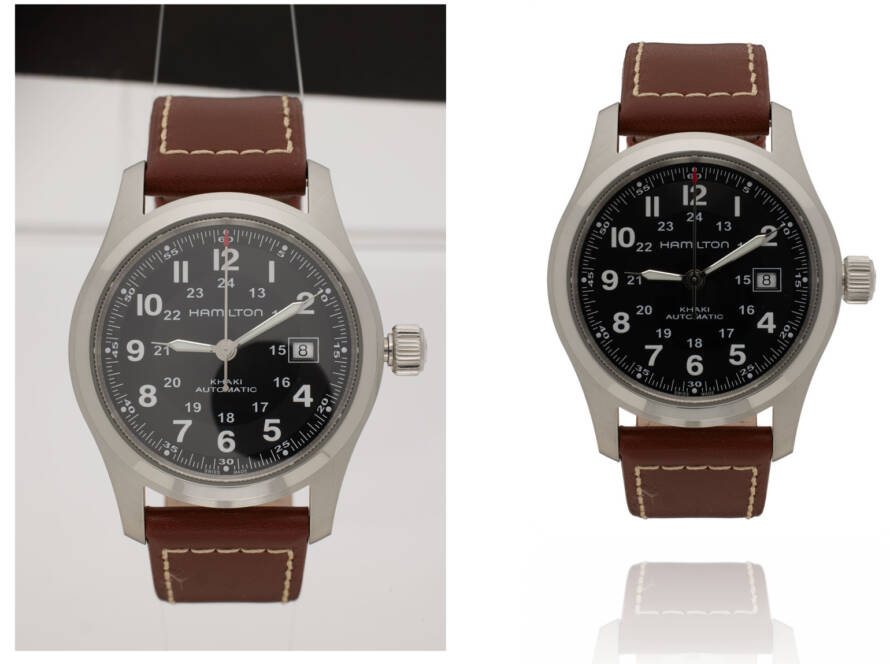
High-end photo retouching doesn’t change the product — it elevates how customers perceive it.

ROI of Professional Product Photography
Return on Investment (ROI) measures how much revenue is generated compared to the cost spent.
Professional product photography delivers ROI in multiple ways.
1. Increased Sales Conversion
Clear and attractive images encourage customers to buy.
Better visuals often result in:
- Higher click-through rates
- Improved engagement
- More completed purchases
Even a small increase in conversion rate can produce substantial revenue growth over time.
2. Reduced Product Returns
Returns are expensive and disruptive.
Many returns happen because customers receive products that do not match their expectations.
Professional photography helps reduce returns by:
- Showing accurate colors
- Displaying product dimensions clearly
- Highlighting details and features
When customers know what to expect, they are less likely to return items.
3. Improved Brand Trust
Customers associate image quality with brand quality.
Professional visuals create:
✔ Strong brand credibility
✔ Premium perception
✔ Customer confidence
Trust plays a major role in customer retention and repeat purchases.
4. Faster Product Launch Cycles
Structured visual workflows allow brands to publish products faster.
Professional teams follow standardized processes that ensure:
- Quick image turnaround
- Consistent editing
- Ready-to-upload formats
Faster launches mean faster revenue generation.

Building Visual Systems That Scale
Professional photography alone is powerful, but when combined with structured workflows, it becomes a scalable system.
Here’s how successful brands build visual systems.
Standardized Photography Guidelines
Consistency starts with clear rules.
These include:
- Background color standards
- Lighting setup requirements
- Product positioning rules
- Camera angle selection
Standardization ensures that all product images look uniform.
Batch-Based Production Workflows
Instead of photographing products individually, many brands organize products into batches.
This improves:
✔ Speed
✔ Efficiency
✔ Cost control
Batch workflows allow teams to process large product volumes without delays.
Professional Retouching and Editing
Raw photos rarely look perfect.
Professional retouching improves:
- Dust removal
- Color balance
- Shadow adjustments
- Texture refinement
Retouching transforms basic photos into high-quality product visuals.
Multi-Platform Optimization
Modern products appear across multiple platforms, including:
- Websites
- Marketplaces
- Social media
Each platform has unique image requirements.
Visual systems ensure:
- Correct dimensions
- Fast-loading images
- Platform compatibility
This prevents formatting errors and improves user experience.
Measuring the ROI of Visual Systems
Businesses should track performance metrics to understand visual ROI.
Important metrics include:
✔ Conversion Rate
✔ Return Rate
✔ Customer Engagement
✔ Average Order Value
✔ Product Page Performance
When visual quality improves, these metrics often show measurable growth.
Tracking performance allows businesses to refine their visual strategies over time.
The Hidden Cost of Poor Product Images
Low-quality images create more problems than most businesses realize.
Common issues include:
- Reduced customer trust
- Lower product visibility
- Increased returns
- Lost revenue opportunities
Poor visuals also damage brand reputation.
Customers often assume that low-quality images reflect low-quality products.
Investing in professional visuals prevents these costly mistakes.
Future Trends in Professional Product Photography
Visual systems are evolving rapidly.
Key trends include:
- AI-assisted image editing
- Automated background removal
- Smart workflow management
- Real-time image optimization
However, professional expertise remains essential.
Technology enhances productivity, but human creativity ensures visual excellence.
Brands that combine technology with professional workflows will lead the next phase of eCommerce growth.
Best Practices for Maximizing Visual ROI
To achieve the highest return from professional photography, businesses should:
✔ Maintain consistent visual standards
✔ Invest in professional editing
✔ Optimize images regularly
✔ Monitor performance metrics
✔ Update visual workflows periodically
These practices help sustain long-term revenue growth.
Conclusion
Visual systems are no longer optional — they are essential for scaling revenue in modern eCommerce.
Professional product photography delivers measurable ROI by increasing conversions, reducing returns, and strengthening brand trust.
When combined with structured workflows and consistent visual standards, product images become powerful revenue-driving assets.
Businesses that treat visuals as strategic investments — not expenses — are better positioned to compete, grow, and succeed in the evolving digital marketplace.
FAQs
What is the ROI of professional product photography?
The ROI of professional product photography comes from increased conversions, reduced returns, and improved brand perception.
Why are product images important for eCommerce sales?
Product images help customers understand products clearly, build trust, and make purchase decisions faster.
How do visual systems help scale revenue?
Visual systems improve efficiency, maintain consistency, and support faster product launches, leading to increased sales.
Can better product images reduce returns?
Yes. Accurate and detailed images reduce misunderstandings and help customers choose the right product.